
Intelligence
Only 942 days to go...

“An intelligent person is never afraid or ashamed to find errors in his understanding of things.” ~Bryant H. McGill
I recently finished taking a class at OLLI-UNCA that presented the history of the Battle of Britain. It was fascinating and I learned a lot. In the summer of 1940, Britain was alone, after France had fallen. The Wehrmacht was poised on the other side of the English Channel after having pushed the British out at Dunkirk. Hitler’s generals were drawing up the plans for Operation Sea Lion — the invasion of England. All that stood between Adolf Hitler and total domination of Western Europe was the Royal Air Force, badly outnumbered, flying from battered airfields in the southeast of England, trying to hold the line.
What saved Britain was not just the courage and sacrifice of the RAF and their heroic pilots, but was also British intelligence. The British had cracked Germany’s Enigma cipher machine. Working out of a Victorian estate north of London called Bletchley Park — staffed by mathematicians, linguists, crossword puzzle champions, and chess grandmasters — a team of codebreakers had done what the Germans believed was mathematically impossible. They were reading the enemy’s mail. During the Battle of Britain, a direct line ran from Bletchley Park to Fighter Command headquarters at Bentley Priory. When Reichsmarschall Göring launched his great offensive in August 1940 — Eagle Day, intended to annihilate the RAF — British commanders often knew German targets and force compositions before the Luftwaffe bombers had even crossed the channel.
But Bletchley Park was only part of the picture. Britain had also built what was then the most sophisticated air defense network in the world — the Dowding System, named for Air Chief Marshal Hugh Dowding — which wove together radar stations along the coast, reports from the Observer Corps on the ground, and real-time communications to sector stations that could vector fighters toward incoming raids with remarkable precision. It was rudimentary and unsophisticated by today’s systems. But the radar gave early warning, and human observers filled the gaps. The system worked because the intelligence was integrated, trusted, and a respected component that saved the British from German annihilation.
When the Japanese attacked Pearl Harbor on December 7, 1941, there were plenty of warning signals, including intercepts, diplomatic cables and fleet movements, but there was no system capable of connecting them into a coherent picture. Nearly 2,500 Americans died in a surprise attack that, in retrospect, was hiding in plain sight.
That catastrophic failure of coordination produced one of the most consequential acts of peacetime governance in American history: the National Security Act of 1947. President Harry Truman signed it into law, and it created the architecture of American national security that would define the Cold War and beyond. The Act established the Department of Defense, the Joint Chiefs of Staff, the National Security Council — and the Central Intelligence Agency, built to ensure that never again would scattered, siloed intelligence agencies fail to share information that could prevent an attack on the United States.
For the next half century, the CIA built a formidable institutional capability. It was imperfect, but it represented the accumulated expertise of generations of analysts, case officers, signals specialists, and counterintelligence professionals who spent careers mastering some of the most complex and dangerous terrain on earth. Tracking Soviet nuclear capabilities, monitoring Warsaw Pact movements, understanding what was happening inside closed societies — these were not tasks for political loyalists. These tasks required expertise, continuity and, above all, the ability to tell decision-makers things they did not want to hear.
On the morning of September 11, 2001, nineteen men boarded four commercial airplanes and killed nearly three thousand Americans. The CIA had known that at least two of the eventual hijackers, Khalid al-Mihdhar and Nawaf al-Hazmi, had al-Qaeda connections and had entered the United States. The CIA failed to share that information with the FBI. The two agencies, despite decades of nominal coordination, were operating in separate worlds, each guarding information with institutional turf. It took only a few days before the attacks for the CIA to share what it knew about al-Mihdhar with other agencies. By then, it was far too late. On September 11th, al-Mihdhar flew American Airlines Flight 77 into the Pentagon.
Once again, the inability to connect the dots ranked among the worst intelligence failures in American history. Despite the collapse of the Soviet Union a decade earlier, the intelligence community remained trapped in a Cold War mindset, structured for a threat that no longer existed, unprepared for the one that did. The Commission found 340 specific recommendations for intelligence reform that had been made by prior reviews and found that nearly 80% of them had never been implemented.
What followed was the most sweeping restructuring of American intelligence since 1947. Congress created the Office of the Director of National Intelligence, meant to sit above the various agencies and force the kind of coordination that had failed so catastrophically. The Department of Homeland Security was established. Fusion centers were built. Information-sharing protocols were mandated. Cybersecurity, long an afterthought, began to get serious resources and serious attention. It was painful, expensive, bureaucratically contentious work — but it was done. Slowly, imperfectly, the intelligence community rebuilt itself around the threats of the twenty-first century: transnational terrorism, state-sponsored cyber operations, sophisticated disinformation campaigns, and adversaries who had studied American vulnerabilities with great care.
I acknowledge that intelligence doesn’t always get it right. The failure of the Iraq WMD assessment, which helped launch that war is a sobering reminder of that. But for every public failure, there are countless successes we will never know about where terrorists’ plots have been disrupted and attacks prevented. That’s the nature of the work. Intelligence that succeeds leaves no headlines. You only hear about it when it fails. That asymmetry makes it dangerously easy to dismiss the importance of their work.
Effective intelligence isn’t a luxury. It is a necessity. While it has not been perfect, at very least, the efforts have been serious and the people doing the work have been both consistent and professional. And it represented an institutional capacity that had taken decades and countless dollars to construct.

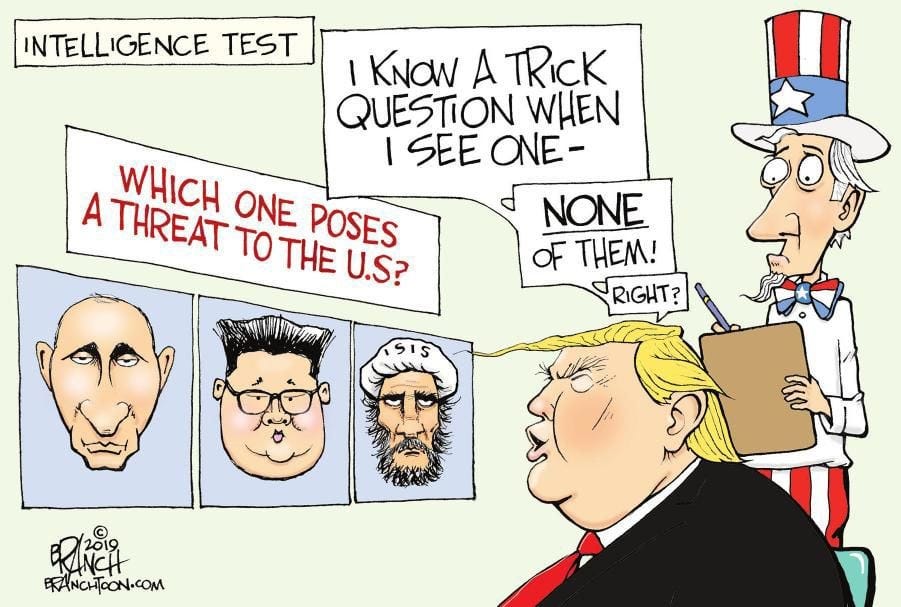
The current President of the United States has made clear, in his own words, across both of his administrations, that he rejects the role of intelligence entirely. As far back as 2016, when asked whether he trusted American intelligence, Trump told FauxNews: “Not so much from the people, that have been doing it for our country.”
None of this should surprise anyone who was paying attention during Trump’s first term. In July 2018, standing alongside Vladimir Putin in Helsinki, just days after a federal grand jury had indicted twelve Russian intelligence officers for election interference, Trump was asked whether he believed his own intelligence agencies or Putin’s denial. His answer was both unambiguous and inconceivable: “My people came to me, Dan Coats came to me, and some others. They said they think it’s Russia. I have President Putin — he just said it’s not Russia. I don’t see any reason why it would be.”
The Director of National Intelligence, immediately issued a public statement contradicting his own president. And if Helsinki wasn’t clear enough, Trump told the Washington Post that same year: “I have a gut, and my gut tells me more sometimes than anybody else’s brain can ever tell me.” He does have a rather large gut — how intelligent it is, is clearly open for debate considering the mess he has created with Operation Epic FUBAR in Iran. This has been his governing philosophy. The Trump administration has approached the American intelligence community the way a demolition crew approaches a condemned building with the apparent indifference of what it took to build.
Since January 20, 2025, the intelligence purge began almost immediately. Career intelligence officers were fired or offered buyouts. At least 51 CIA and Office of the Director of National Intelligence officers faced imminent dismissal over their temporary assignments to diversity programs. Deferred resignation offers went out to CIA, NSA, and ODNI staff. The CIA announced plans to cut 1,200 positions, with thousands more cuts spread across the broader intelligence community. Under Director of National Intelligence Tulsi Gabbard, ODNI underwent what it called “ODNI 2.0” or the reduction or reassignment of staff by 40 percent, consolidating analytic functions, discontinuing long-standing institutional products including the Global Trends report. Critics argued the changes didn’t streamline the agency so much as gut its institutional memory and analytic independence. At the time, Hillary Clinton’s accusations that Gabbard was a Russian asset were widely ridiculed — but watching what Gabbard did to the American intelligence community during her tenure makes it not so easy to laugh off anymore.

The CIA and ODNI have not been the only targets with Trump’s purge. At the FBI, Kash Patel set about transforming the nation’s premier domestic investigative agency into a vehicle for personal and political retribution. Senior field office leaders were purged. Agents who had worked the Mar-a-Lago classified documents case were fired. Counterintelligence specialists with expertise in Iran were removed — this, notably, just days before Trump launched a military strike against Tehran. The top officials overseeing the FBI’s work on terrorism, cybersecurity, human trafficking, and violent crime were swept out in waves. Patel’s need to punish his perceived enemies was apparently greater than his interest in protecting the American people. Iran-linked hackers, apparently sensing an opportunity, breached Patel’s personal email. The bureau that had spent decades building expertise in the threats most likely to kill Americans was being hollowed out in real time.
And over at the Pentagon, the Pentagon’s Special Operations and Low Intensity Conflict office, a sensitive Defense Department branch responsible for uncovering and defending against terrorism plots and asymmetric warfare, has a new asset: a January 6th rioter who pleaded guilty to climbing through a broken window at the Capitol and to other offenses. Elias Irizarry, who was 19 on Jan. 6, 2021, eventually was pardoned for his actions and is now working in our DOD. Swell.
In May, Gabbard resigned, citing her husband’s cancer diagnosis as the reason for stepping down. But given that she had reportedly been kept out of key deliberations during Trump’s current misguided military conflict with Iran and even sidelined from the very intelligence decisions expected of a Director of National Intelligence, one is left to wonder whether this was truly a resignation or something closer to a forced exit. Either way, she is now gone.
What came next was not even close to a serious attempt to find a qualified successor. It was something closer to finding a warm (and loyal) body to fill the role. President Trump named Bill Pulte — the 38-year-old nepo-baby to the homebuilding fortune. He has been serving as director of the Federal Housing Finance Agency, overseeing Fannie Mae and Freddie Mac. He now being proposed as the Acting Director of National Intelligence. Pulte will, apparently, keep his other job while also running the nation’s entire intelligence apparatus. As an Acting Director, he conveniently requires no Senate confirmation — which is almost certainly the point of this appointment.
The Atlantic’s Derek Thompson described Donald Trump’s appointment of Bill Pulte as Acting Director of National Intelligence as an example of a “Late Kakistocracy”. He defined this as a phase of democratic decline where a regime promotes unqualified figures to high office because it has run out of capable people willing to work for it.
Pulte had no background in national security. He had no military experience. He had no intelligence experience. He had no foreign policy experience. He did not even appear to have a security clearance — or at least, one was not confirmed at the time of his appointment. He studied broadcast journalism. Before his current role, he founded a private equity firm and a nonprofit that demolishes abandoned homes.
The reaction to his selection (with the exception of Steve Bannon and Tommy Tuberville) was swift and, remarkably, bipartisan: “O-M-G.”
Senator Mitch McConnell stated flatly that the DNI position carries a statutory requirement for “extensive national security expertise” and that any nominee who falls short of that standard would not earn his vote. Senator John Cornyn of Texas, a senior member of the Senate Intelligence Committee, expressed his own reservations. The law itself, the statute that created the DNI position, explicitly requires the officeholder to have extensive national security expertise. Pulte had none.
The backlash was intense enough that it forced Trump to make a course correction. Under bipartisan congressional pressure, Trump announced on June 11th that he would nominate Jay Clayton — the U.S. Attorney for the Southern District of New York and former chairman of the Securities and Exchange Commission — as the permanent Director of National Intelligence. The Pulte appointment had also become a flashpoint in Congress over the renewal of Section 702 of FISA — the surveillance authority used to monitor foreign threats — with Democrats refusing to extend it so long as Pulte remained in control of the intelligence apparatus. That program expired on June 13th, a direct casualty of the standoff.
The bipartisan rebuke produced a new name, but not necessarily a better answer. Clayton’s résumé is more distinguished than Pulte’s, but the fundamental problem remains: the statute creating the DNI position explicitly requires the officeholder to have extensive national security expertise. Clayton, despite his credentials as a Wall Street lawyer and corporate regulator, has none of that either. Senator Richard Blumenthal called Clayton “a vast improvement” over Pulte — but pointedly questioned “whether he has experience in the area of national intelligence.” The bar, it seems, was merely moved; it was not raised.
And then, just as quickly as the problem seemed solved, Trump blew it up himself.
The Senate Intelligence Committee had scheduled a confirmation hearing for June 17th, moving at unusual speed to limit Pulte’s time in the role. Then, in an early-morning Truth Social post, Trump abruptly declared he was “cancelling” the hearing. He accused Senate Republicans of moving too fast, claimed they had “fallen into a trap” set by Democrats, and issued a new set of demands: he would not allow the hearing to proceed until the Senate confirmed his separate pick for U.S. Attorney for the Southern District of New York, and he threatened to block FISA reauthorization unless it was bundled with the SAVE America Act — his voter ID legislation that lacked the votes to pass even in a Republican-controlled Senate.
The moment exposed a striking intra-party rupture. Senate Intelligence Committee Chairman Tom Cotton initially pushed back, writing that the committee would “proceed with his hearing as scheduled unless the president directs him not to appear or withdraws his nomination.” Within hours, Cotton was overruled. Trump directed Clayton not to appear, and Cotton conceded. Senate Majority Leader John Thune, left to explain the chaos to reporters, said only that they would “have to take it a day at a time.”
Senator Mark Warner, the ranking Democrat on the Intelligence Committee, called it an “extraordinary display of dysfunction,” adding that the biggest obstacle to resolving the crisis “has not been Senate Democrats or Senate Republicans — it has been the chaos and confusion coming from the White House itself.”
Senators have urged Trump to let the process resume, warning that the nation is “playing with fire” without FISA reauthorized. Bill Pulte remains as Acting Director of National Intelligence. Clayton’s nomination is technically still alive, but its fate is hostage to Trump’s legislative grievances which is a set of demands that have nothing to do with national security and everything to do with the president’s political agenda.
This is where the story ends, for now: a critical intelligence authority expired, the nation’s spy apparatus is led by an unqualified housing official who uses his roles to pursue the president’s enemies, and a more qualified nominee has been deliberately blocked by the president who nominated him. Whatever comes next, the pattern is now unmistakable. The nation’s spy chief will be less focused on foreign threats than on domestic ones and more specifically, on the administration’s political opponents. This is the deliberate placement of a loyalist with no relevant expertise at the top of an institution whose entire value depends on its independence, its professionalism, and the trust that adversaries, allies, and the American public can place in its judgments.
The lesson of Bletchley Park, of Pearl Harbor, of 9/11, is always the same: when intelligence fails — through neglect, through arrogance, through the subordination of expertise to politics — people die.
What is being done to the American intelligence community right now is neither budget efficiency nor a thoughtful reorganization. It is the deliberate destruction of institutional capacity. It’s all about using the levers of government for personal revenge.
Socrates is quoted as saying: “The only true wisdom is in knowing you know nothing.”
Trump is quoted as saying: “I have a gut, and my gut tells me more sometimes than anybody else’s brain can ever tell me.”
Between these two men, there is only one understands wisdom… the other relies on his gut.
So where is the intelligence in that?
Thought for the day in honor of his birthday…
“Sometimes it is the people who no one imagines anything of who do the things that no one can imagine.”
~Alan Turing
Worth reading
Scoop: CIA director doubts Iran’s intentions on deal
CIA Director John Ratcliffe told President Trump and other senior officials that evidence gathered by U.S. intelligence agencies raises serious doubts about Iran’s willingness to make the nuclear concessions the U.S. is seeking in any final deal, according to three sources familiar with those discussions.
Friction point: Ratcliffe isn’t the only skeptic in Trump’s top team. In internal discussions, Secretary of State Marco Rubio and Secretary of Defense Pete Hegseth both expressed concerns and raised questions about the memorandum of understanding (MOU) announced Sunday, while Vice President Vance and U.S. envoys Steve Witkoff and Jared Kushner advocated for it, according to two of the sources.
The nuclear issue – along with core issues such as ballistic missiles and Iran’s proxies – has been deferred for 60 days. This raises two important questions: What was the war actually for? And what did the U.S. achieve?
As an international and nuclear security expert, I believe the answer is nothing – and in the process the U.S. lost credibility as a negotiating partner.
Trump’s Strange Choice for Director of National Intelligence The president’s selection of Bill Pulte is both baffling and predictable.
Bill Pulte does not have a habit of publicly saying admiring things about Vladimir Putin or Bashar al-Assad, so in that one respect his appointment as acting director of national intelligence represents an improvement over Tulsi Gabbard.
In every other respect, the appointment is baffling. Pulte has no intelligence background; no national-security expertise. He’s an ultra-partisan with a highly quarrelsome personality and great inherited wealth. Beyond that, there’s not much to say about his record of public or personal achievement.
One Reason Trump Might Have Chosen His New Intelligence Chief Bill Pulte has no national-security experience, but he does have one qualification that might appeal to the president.
Three things about Pulte are important to know: First, he has no apparent intelligence experience. Second, he is being assigned to fill an important government-coordination position, but his brief track record shows that he has a tendency to clash with and infuriate colleagues rather than work with them. Third, the most notable thing that Pulte does bring to the role is a demonstrated history of using sensitive government data for political retribution.
Trump’s New DNI is a Nepo Baby Who Got His Job Because of MAGA Affirmative Action What do Tulsi Gabbard and Bill Pulte have in common? They’re both horrible.
Pulte has no national security background and no apparent qualifications for the immensely consequential job of DNI. What he does have is a fearsome loyalty to the president, and a demonstrated track record of politicizing the levers of federal power to advance Trump’s agenda—and silence the president’s critics…It’s predictable, at this point, that Trump would tap an industry scion with no record of public service to run one of the nation’s key federal housing regulators.
The star turn for Pulte came after Trump re-entered office with a self-proclaimed mandate for “retribution.” As the head of FHFA, Pulte set about investigating Trump’s opponents who spoke out against him. To do so, he alleged mortgage “fraud” charges, for which Fannie Mae’s own internal investigators have said there is no clear evidence. Among his targets are New York Attorney General Letitia James, Sen. Adam Schiff (D-Calif.), and Federal Reserve Governor Lisa Cook.
Trump Says Bill Pulte, His New Intelligence Director, Should Slash Staff; Trump says he wants his new acting director of national intelligence to cut the office
President Trump called on Friday for his choice to temporarily run the Office of the Director of National Intelligence to conduct mass firings of employees who “shouldn’t be there.”
Mr. Trump, in an interview with The Wall Street Journal, also said his pick, Bill Pulte, would be “less shackled” by the constraints of being the president’s choice to lead the agency permanently.
“It sort of gives you more power, you know, for a somewhat limited period of time,” Mr. Trump added.
The comments are the most expansive that Mr. Trump has made about Mr. Pulte, who runs a lesser-known agency, the Federal Housing Finance Agency, and has no known national security experience. Mr. Trump on Monday announced Mr. Pulte as his choice to replace Tulsi Gabbard as the director of national intelligence.
Former Trump intelligence official Amaryllis Fox Kennedy has revealed why she stepped down from her multiple roles in the administration last month. RFK Jr’s daughter-in-law had claimed she was stepping down as deputy director of national intelligence and leaving the President’s Intelligence Advisory Board “to keep her family financially on track”. But speaking to The Wall Street Journal, Fox Kennedy said she actually quit over concerns about the CIA’s use of taxpayer funds, particularly the unsupervised movement of gold bullion.
C.I.A. Officer Found With Gold Bars Said to Have Created Fake Spy Program
A C.I.A. employee who was found recently with $40 million of gold bars in his house had created a secret intelligence program to funnel millions of dollars from the federal government to himself, according to two U.S. officials.
David Rush, the employee, created a fake “special access program,” a sensitive intelligence tool that has highly limited visibility even within the C.I.A., the officials said.
Senators Warn of Intelligence Gaps if Surveillance Program Expires
In a letter to Secretary of State Marco Rubio, who is also the national security adviser, Senator Tom Cotton of Arkansas, the chair of the Intelligence Committee, and Senator Charles E. Grassley of Iowa, who leads the Judiciary Committee, said they believed that Section 702 of the Foreign Intelligence Surveillance Act may not be renewed before it expires on June 12, despite weeks of bipartisan negotiations aimed at preserving the program.
Those negotiations fell apart on Friday after Democrats refused to back a renewal because of concerns over President Trump’s recent appointment of Bill Pulte, a close ally and the federal housing director, to oversee the nation’s intelligence agencies. The defeat left uncertain the future of Section 702, which allows intelligence agencies to collect communications of foreign targets overseas — including when they are communicating with Americans.
The One War Trump Is Winning Is the One Against Us
That’s right. Each and every week, he is weakening us and strengthening our enemies. Each and every week, he is squandering resources on vainglorious, dangerous, or corrupt projects. Each and every week, we become more vulnerable to overseas threats even as he conspires to create greater ones at home—threats to our elections this fall, threats to our fundamental freedoms, threats to our way of life.
New material
President Donald Trump said Thursday he is nominating Jay Clayton, the U.S. attorney for the Southern District of New York and a former Securities and Exchange Commission chairman, as director of national intelligence.
Trump announced the nomination on social media amid pressure from Congress to name a permanent replacement for Tulsi Gabbard, who announced her resignation last month. Trump faced intense pushback over his decision to name Bill Pulte, head of the Federal Housing Finance Agency, as acting director. The job oversees the coordination of 18 intelligence agencies.
The resulting uproar led to a standoff in Congress after Democrats said they would refuse to renew foreign intelligence powers unless Trump pulled Pulte’s nomination and named a permanent nominee.
“Few people anywhere in the Legal Community are respected at the level of Jay,” Trump wrote. “I encourage the United States Senate to confirm Jay as soon as possible.”
Speaking later Thursday in the Oval Office, Trump said he still plans to keep Pulte in the role “for a little while” after earlier saying he wants Pulte to downsize the office. He called Clayton an “incredible talent” and said, “Nobody has better credentials.”