
Fork in the road
Only 941 days to go...

“And to whomsoever much is given, of him shall much be required.” ~Luke 12:48
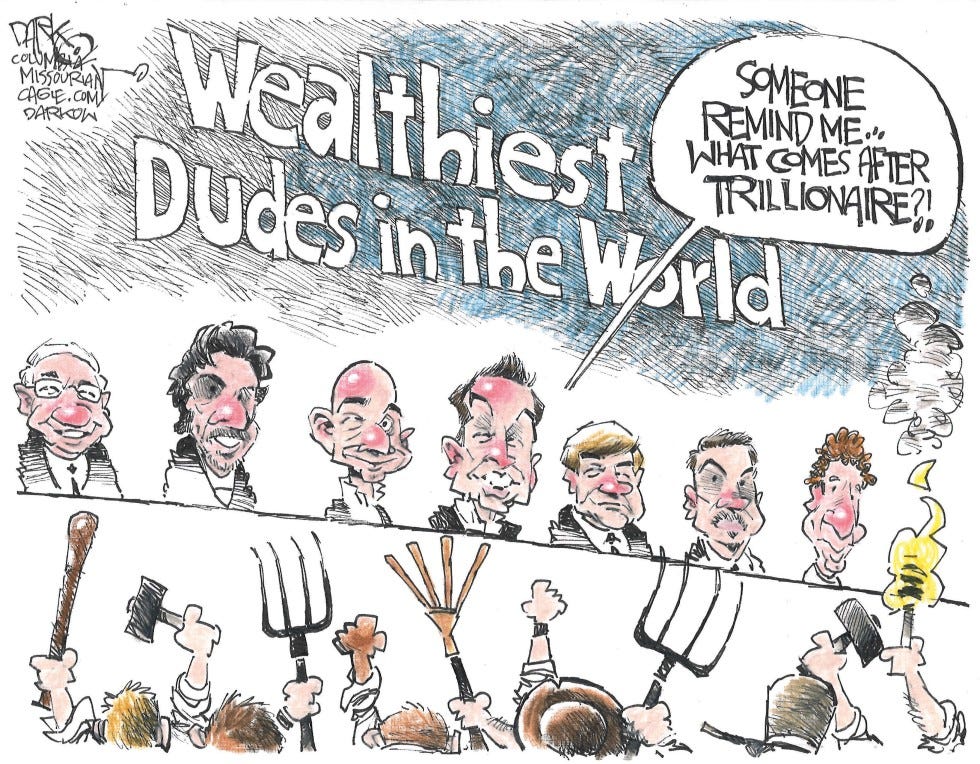
I’m sure you read about this – it was certainly all over the news. When SpaceX recently debuted on the Nasdaq at a valuation of $1.77 trillion, Elon Musk became the first human being in recorded history to accumulate a personal fortune exceeding one trillion dollars. As one economic historian noted, Musk may well be “the wealthiest person who has ever lived — excluding emperors or other rulers whose wealth is not easily distinguishable from that of the state.” As a trillionaire, Musk is worth roughly 3% of the entire U.S. GDP.

Musk did not become a trillionaire by selling his companies or cashing out his wealth in any conventional sense. He did it by pledging his shares — in Tesla, SpaceX, X — as collateral for enormous personal loans, borrowing against his paper fortune while paying minimal taxes and giving virtually nothing away. This is the “buy, borrow, die” strategy now perfected by the ultra-wealthy: acquire assets, pledge them for tax-free loans to fund your lifestyle and your political ambitions, then pass the estate to your heirs with the tax bill reset. No income realized. No taxes paid. No obligation fulfilled. At one point, Musk had pledged $94 billion in Tesla shares as personal collateral — a sum larger than the GDP of most countries — while simultaneously running a branch of the U.S. government, pursuing a SpaceX IPO, and fighting OpenAI in court. The conflicts of interest were not incidental.

Department of Government Efficiency (DOGE) is a temporary organization established by Trump via executive order on January 20, 2025. Under Elon Musk, the unit was tasked with modernizing agency workflows, slashing regulatory waste, and decreasing federal overhead. Many engineers departing the program have transitioned to building private, venture-backed tech companies targeting government and defense sectors.
One of the government programs that Musk targeted early was the United States Agency for International Development. Historically, it served as the principal independent federal agency responsible for administering billions of dollars in civilian foreign aid and humanitarian assistance worldwide. USAID cost American taxpayers less than one percent of the federal budget — roughly $105 per American per year. For that price, USAID-funded programs prevented an estimated 92 million deaths from HIV/AIDS, malaria, tuberculosis, and malnutrition. The PEPFAR program saved an estimated 26 million lives and provided antiretroviral medication to 20 million people at the time it was gutted.
Musk’s DOGE dismantled it: 83 percent of USAID programs canceled, 5,200 contracts terminated, thousands of experts fired. The agency that had operated for 64 years was reduced, in the words of one report, to a black plastic shroud over its Washington headquarters sign.
What did DOGE actually save? Musk promised $2 trillion, then $1 trillion, then $150 billion — a figure outside analysts put at closer to $16 billion once inflated numbers and already-planned cancellations were stripped out. Even the most generous estimate amounts to just six percent of the deficit increase from the tax bill that Trump signed the same year. Researchers now project the global aid cuts could lead to at least 9.4 million additional deaths by 2030. Another study puts that number as high as 14 million.
The world’s wealthiest man, whose fortune grew by $500 billion in a single year, directed the elimination of an agency saving millions of lives annually — for disputed savings that may be dwarfed by the $6 billion cost of the shutdown itself. And even today Musk continues his destruction elsewhere. Recently he has been heavily accused by British and Irish authorities of stoking division and fueling anti-immigrant race riots in Belfast, Northern Ireland.
Sad. Just think about the uplifting difference this man could make with his trillions.
“I can’t conceive of having $100 million. I can conceive of sitting here and saying, where can this money do the most good? Whose life can be made better? Musk seems to think in terms of what judge can I buy … And when you are able to make stuff just go away with money, you are no longer an accountable member of society. Basically, you are a little sovereign nation living within a democracy and bending its rules so that you can do anything you want. And that is not a healthy society.” ~Tom Nichols

We’ve been here before. In the late 1860s to roughly 1900, the Gilded Age was a period of rapid economic growth and industrialization, but also of severe poverty, political corruption, and deep social inequality. The name comes from the 1873 novel by Mark Twain and Charles Dudley Warner called The Gilded Age: A Tale of Today. The title was a metaphor: the era looked shiny and prosperous on the outside, but underneath it was riddled with greed and exploitation.
Tycoons like John D. Rockefeller, Andrew Carnegie, and Cornelius Vanderbilt built massive monopolies. A tiny fraction of the population accumulated unprecedented fortunes and built lavish mansions, while millions of working-class families lived in crowded, disease-ridden city tenements. Cities grew at a breakneck pace, fueled by new factory jobs. Factories had dangerous working conditions, long hours, and low pay. Farms during the Gilded Age were highly productive and mechanized, yet small farmers frequently faced devastating debt, deflation, and poverty. Politicians accepted bribes, and business tycoons held immense influence over government policies.
The robber barons of the era were no angels. Carnegie broke strikes with Pinkertons. Rockefeller crushed competitors with a ruthlessness that bordered on sociopathy. Leland Stanford built his railroad fortune on the backs of Chinese laborers he later tried to exclude from the university he founded in his son’s name. J.P. Morgan had the U.S. government over a barrel more than once and knew it.
But here is the big difference with today. At least eventually, they believed that great wealth carried an obligation. Carnegie gave away over 90 percent of his fortune, building 2,500 libraries and writing The Gospel of Wealth, arguing that the rich man who dies rich dies disgraced. Rockefeller funded the development of the University of Chicago and assisted Yale and Spellman College. Morgan used his personal fortune to rescue the U.S. financial system in 1907. Leland and Jane Stanford founded an entirely free university in memory of their son — free for decades, a radical act of public generosity. The richest man in Chicago, Marshall Field, founded the Field Museum of Natural History with gifts that eventually totaled nearly $10 million, donated land to the University of Chicago, and was a founder of both the Art Institute of Chicago and the Chicago Symphony Orchestra.
These were imperfect people operating in an imperfect system. But they understood that wealth accumulated in a society creates an obligation to that society. Call it noblesse oblige or guilt or even enlightened self-interest. Whatever you call it, it produced libraries, hospitals, universities, and concert halls.
That spirit did not entirely die. As recently as 2010, Warren Buffett and Bill Gates created the Giving Pledge — a public commitment asking the world’s wealthiest individuals to donate the majority of their fortunes to philanthropic causes. It was an attempt to codify what Carnegie had preached: that extreme wealth carries extreme obligation. Over 240 billionaires across 30 countries signed. It felt, briefly, like a new norm taking hold — like the old sense of noblesse oblige had survived into the age of the tech billionaire.
Then came Trump.
Now let us talk about what today’s class of hyper-wealthy has built. Starting at the top:
Trump’s Foundation. When the New York Attorney General investigated the Donald J. Trump Foundation, she found “a shocking pattern of illegality” — unlawful coordination with his 2016 presidential campaign, repeated self-dealing, and the use of charitable funds to pay off private legal obligations and decorate his clubs with purchased art. The foundation was dissolved under court supervision. Trump was ordered to pay $2 million in restitution and make 19 admissions of personal misuse of funds. It was not a case of insufficient generosity. It was a case of using a charity as a personal ATM.
Jeff Bezos. Amazon’s Bezos spent between $46 and $55 million alone on three days of festivities in Venice for his second wedding. Bezos had already killed the editorial independence of the Washington Post in a move widely read as a bow to political expediency. The world’s third-richest man has wrapped himself in conspicuous consumption. Fortunately, some of the wealth is being shared by his ex-wife, Mackenzie Scott. She gave away $7.2 billion last year — more than Bezos has donated in his lifetime.
Larry Page. Google's co-founder and one of the most powerful architects of the modern internet, worth over $130 billion, has constructed an intellectual argument for why he shouldn't have to. In a 2014 interview, Page told Charlie Rose he would rather leave his fortune to Elon Musk than to charity, arguing that visionary corporations do more good for humanity than philanthropy. His foundation — the Carl Victor Page Memorial Foundation — has assets of $6.7 billion, yet for over a decade sent 99.9% of its grants not to working charities but to donor-advised funds: a charitable giving account that allows you to contribute cash or assets, take an immediate tax deduction, and then recommend grants to eligible charities on your own timeline. No one can determine whether the more than $1.2 billion deposited there has ever reached a charitable organization.
Mark Zuckerberg. In 2015, Zuckerberg pledged 99% of his Facebook shares to the Chan Zuckerberg Initiative (CZI), dedicated to “advancing human potential and promoting equal opportunity.” Then, after Trump’s re-election, he systematically dismantled it. CZI shuttered the free school Priscilla Chan had built in East Palo Alto, abandoned the immigration advocacy group Zuckerberg himself cofounded, and slashed grants to hundreds of Bay Area nonprofits without warning. One leader described losing a third of his funding in a single call: “That was it: ‘Over, thank you, bye.’” Internally, staffers said the retreat was about politics. Zuckerberg “needs something from the president of the United States... These cuts are part of Mark Zuckerberg fighting for his No. 1, which is his bottom line.” Carnegie gave his money away. Zuckerberg used philanthropy as a PR instrument — and when the politics shifted, so did the philanthropy.
Larry Ellison. At $393 billion, Ellison signed the Giving Pledge in 2010, committing to donate 95% of his wealth. Fifteen years later, the pledge remains largely a pledge. He has made significant donations — $200 million to USC, roughly $1 billion through his now-closed medical foundation — but these are a rounding error against a fortune that has grown by hundreds of billions. He has bought 98% of Lanai, dozens of luxury properties, mega-yachts, and a $173 million Florida mansion. Like Musk, he funds his lifestyle by pledging Oracle shares as collateral for personal loans. His Ellison Institute of Technology has been roiled by leadership departures amid questions about whether Ellison will deliver on his commitments at all.
Peter Thiel. And then there is Peter Thiel, who is in a category of his own. Thiel, the co-founder of PayPal and Palantir is worth roughly $24 billion. He has never signed the Giving Pledge. What he is doing instead is actively working to convince other billionaires to abandon it. In an interview with the New York Times, Thiel called the Giving Pledge an “Epstein-adjacent, fake Boomer Club” and said he has privately encouraged around a dozen signatories to cancel their pledges. He personally warned Musk not to give his money away, telling him it would go “to left-wing nonprofits that will be chosen by Bill Gates.” When Coinbase CEO Brian Armstrong quietly removed his name from the Pledge in 2024, Thiel sent him a congratulatory note.
What does Thiel do with his money instead? He buys political power. He donated $15 million to JD Vance’s 2022 Ohio Senate campaign — the largest individual Senate donation in history at the time. He mentored him at Yale, employed him, introduced him to Trump at Mar-a-Lago, and lobbied for him to be vice president. The man, now next in succession, if anything happens to the Felon, is a Thiel creation. His company Palantir has netted over $113 million in federal contracts since Trump’s second term began and is building a platform for ICE to track migrant movements in real time. This is Thiel’s version of giving back: a surveillance apparatus, a vice president, and a political infrastructure designed to keep government friendly to his portfolio. His so-called Thiel Foundation had total assets of $45 million in 2024 and generated $455,000 in annual revenue. In other words, Thiel’s foundation generates less annually than a grassroots not-for-profit organization would need for an operational budget.
What we are watching is the emergence of an oligarchy — not billionaires who happen to be politically connected, but a class of men whose financial power is so concentrated and so intertwined with political access that the normal checks of democracy are being blurred. This is what is now called, The Epstein Class. Jeffrey Epstein was the canary in the coal mine: a man of murky wealth and unambiguous criminality whose “social” network was less a social network than a leverage network with a web of favors, transactions, and compromising information. His story is a cautionary tale about what happens when extreme wealth becomes untethered from accountability.
We see the pattern repeating. Jared Kushner and Ivanka Trump have turned White House access into a $4 billion luxury resort deal in Albania, reclassifying a protected coastal wetland — the Vjosa-Narta lagoon — so their investment firm could build on it. Albanians with real claims to that coastline have been fenced out with barbed wire. Security guards were filmed dragging a protester along a cliff. Anti-corruption prosecutors have frozen developer assets. The EU is watching. And Prime Minister Edi Rama waves away critics with barely concealed contempt.
History is not subtle about what comes next. We are standing at a fork in the road, and both paths have been traveled before.
The first path is the Russian model.
When oligarchy reaches full flower and wealth becomes so concentrated and so intertwined with political power that institutions begin to serve only the few; the corruption metastasizes. The rule of law becomes a tool of the powerful; the military hollows out; and the middle class dissolves. The nation becomes a kleptocracy.
Russia’s top 1% own 58% of household wealth which is the highest concentration in the world. What did those oligarchs build? They built offshore accounts and shadow empires. Russia’s army in Ukraine suffered catastrophic losses in part because the same corruption that enriched the oligarchs had rotted the institutions meant to project national power. The rot at the top was a rot all the way down.
We are not there…yet.
But the distance between where we are and where Russia was in 1995 is shorter than we would like to believe and is getting shorter every day.
“When the people find that they can vote themselves money, that will herald the end of the republic.” ~Benjamin Franklin
The second path is the one we took before.
The first Gilded Age did not end because the robber barons had a change of heart. It ended because the pitchforks came out and the country got angry enough to fight back. It ended because journalists like Ida Tarbell, Upton Sinclair, and Jacob Riis dragged the conditions of the poor into the light, and because a president arrived, who came from the very class he chose to confront. Theodore Roosevelt — wealthy, aristocratic, Republican — looked at the Standard Oil monopoly wrapped around Congress and the courts and said: “We do not wish to destroy the corporations, but we do wish to make them serve the public good.”
He filed 44 antitrust suits. He sided with striking miners. He protected 230 million acres of public land. And the Progressive Era that followed brought the income tax, the direct election of senators, women’s suffrage, child labor laws, and the legal architecture of a middle class. None of it was given voluntarily. All of it was demanded by an organized, furious citizenry that had simply had enough.
That citizenry exists again. You can feel it in the protests outside the Venice wedding, in the streets of Albania, in the fury over DOGE, in the Medicaid fights in state capitals. The question is whether that fury produces the institutions and the leaders to match or whether it dissipates, is divided, or is simply outspent by men who can spend a billion dollars on political influence without meaningfully reducing their net worth.
“Wealth does not fill you. Only purpose will do that.” ~ Rabbi Daniel Gropper
We have been at this fork before. We chose the progressive path. We built a middle class. We created the century of American greatness these present day greedy men seem to want to systematically dismantle.
The thing that converted private wealth into public good, that turned Gilded Age excess into Progressive Era institutions was true generosity. Not charity as a tax strategy or philanthropy as PR. It was generosity as a genuine act of obligation. It was the recognition that no fortune is built in a vacuum, that every billion dollars rests on public roads, public courts, public education, public order, and the labor of people who will never appear some list of billionaires.
Carnegie’s libraries still stand. Rockefeller’s universities still educate. The settlement houses built by women whose names we have half-forgotten still anchor neighborhoods. What they gave endures because it was woven into the fabric of common life. What Musk and Thiel are building, i.e., surveillance infrastructure, political machines, fortunes borrowed against borrowed stock, etc. will not stand in the same way, because it is based on power and not generosity.
For the third consecutive year, Michael Bloomberg landed the No. 1 spot on the Chronicle of Philanthropy’s exclusive ranking of the 50 biggest donors of 2025. The founder of the Bloomberg financial-news empire and former New York mayor gave $4.3 billion to support arts, education, the environment, public health, and programs to improve city governments. Warren Buffett has given more than $60 billion. Bill Gates has donated a total of $63.9 billion. They understand their role in building a better world. They have grasped something essential: that generosity is not weakness. It is the architecture of a society worth living in. It is what separates a civilization from a kleptocracy.
I pray that this Neo-Gilded Age is followed by an enlightened Neo-Progressive Era, with its own Roosevelts, its own muckrakers, and above all its own spirit of generosity: the radical, countercultural, quietly revolutionary idea: “… to whomsoever much is given, of him shall much be required.” The alternative is Russia’s path and we can all see clearly in real time, how that is playing out for the Russian people.
As we stand at the fork in the road, I can only wonder which direction Americans will walk.
Thought for the day in honor of his birthday…
“Watch lest prosperity destroy generosity.”
~ Henry Ward Beecher
Worth reading
How much of Musk’s wealth comes from government help? Virtually all of it
“There would not be (Tesla and SpaceX) if it weren’t for the government,” said Ross Gerber, CEO of investment firm Gerber Kawasaki and an early investor in Tesla.
The federal government awarded SpaceX more than $500 million worth of grants in its early years. And that $500 million is just a fraction of what Tesla received from government grants, loans, contracts and regulatory policies.
Elon Musk’s role was ‘instrumental’ in the Belfast riots, researchers say
Musk amplified calls for protest across Britain from anti-immigration activist Tommy Robinson and wrote to his 240 million followers on X: “Only by protesting REPEATEDLY and LOUDLY will there be any change.” He also boosted anti-immigration posts and messages from Rupert Lowe, leader of the fringe hard-right party Restore Britain, extending his reach to millions of users on the platform.
Researchers from the nonprofit tech watchdog Center for Countering Digital Hate (CCDH) reported that the trio’s posts about Belfast collectively garnered more than 115 million views across their accounts, with Musk accounting for 55 percent of the total.
10 things Elon Musk can — but probably won’t — do with $1 trillion
Elon Musk is now the world’s first-ever trillionaire, after his rocket ship company SpaceX’s record-shattering $2 trillion debut on the NASDAQ…With a mind-numbing net fortune of $1.4 trillion that is growing by the day, Musk is now worth more than the entire economy of Switzerland. He is more than 13 times as wealthy as Bill Gates, and if you are anywhere near middle class, he is over 11 million times wealthier than you. He’s rich enough to collectively purchase every seat for every single World Cup match, every stub in every city on Taylor Swift’s Eras Tour, and every ticket at every Broadway show for the next 10 years or so, while barely making a dent in his gargantuan fortune.
How the Albanian Island of Sazan Became a Global Symbol of Privilege
Zvërnec, north of Vlorë, is located on the waterfront within the protected area of the Vjosë-Nartë Delta: an oasis of amphibian biodiversity, the realm of the monk seal, the most important nursery of caretta caretta turtles, and a permanent base for a hundred species of waterfowl represented on maps for naturalists with the iconic and elegant flamingo. It is here, in one of Europe’s most pristine areas, that the larger of the two Ivanka-and-Jared-branded, ultra-luxury tourist complexes is supposed to be built, although there are many actors in this operation and many of them have very opaque profiles.
America’s Top 25 Philanthropists — And Why Musk, Page And Ellison Aren’t On The List
MacKenzie Scott’s $26 billion giving sprint in seven years, including a record $7.2 billion last year, makes her the third-biggest philanthropist of all-time. She gave more in 2025 than Musk, Page, Ellison and her ex-husband Bezos have in their lifetimes combined.
A Life Hack for the Ultra-Wealthy Is Going Mainstream
House managers are not a nanny or a house cleaner. They’re a “chief of staff for the home,” a “personal assistant for Mom,” and “a clone of myself,” according to the more than a dozen people I spoke with who have either hired one or work as one. They are, in effect, what might have once been called a housekeeper—a person who helps oversee a household’s basic functioning. Middle- and upper-class families used to more commonly employ this kind of position (the title “house manager” dates back to at least the 1830s), but it has become rare enough that a couple of people I spoke with thought they may have come up with the term.
Whatever you call the job, the ultra-wealthy have maintained some version of this role in their homes for years, but more and more companies are cropping up to serve Americans with salaries in the lower six figures—a cohort that is nowhere near having a private jet but might already use a house cleaner or have a regular handyman.
Beyond The Epstein Class: A New Economic Patriotism
They see elite indifference and impunity has led to wealth piling up —into a few hands, in a few places— while vast parts of this country experience stagnation and despair. Workers and communities are treated as dispensable, as they see fortunes being built on offshoring jobs, automating plants, liquidating companies, buying back stock, and harvesting data. Factory towns hollowed out. Main streets emptied. Entire regions left behind.
At the same time, 19 billionaires hold over $3 trillion in wealth ––12.5% of our entire economy. This is a concentration greater than the era of Rockefeller, Vanderbilt, and Carnegie. The inequality is staggering.
We are in a new Gilded Age.
Wages Are Falling. Wealth Is Surging. No Wonder Americans Are Unhappy.
Americans, in survey after survey, say they no longer believe the U.S. economy is working for them. A few people are getting fabulously, unimaginably wealthy at the same time that entire generations of families worry they will never be able to afford to buy a house, raise children or enjoy a comfortable retirement…
Inequality is hardly a new feature in America. But the explosion of wealth at the very top is without precedent in U.S. history. At the height of the Gilded Age at the end of the 19th century, the richest handful of Americans had a net worth equivalent to about 3 percent of the country’s annual economic output, according to data compiled by the French economists Gabriel Zucman and Emmanuel Saez. Today, the fortunes of the same 0.00001 percent — about 20 individuals — make up roughly four times as large a share, equivalent to 12 percent of annual output.